
This week our own crawler told us that every single link on the Citenix blog was broken.
Not "could be improved". Broken. Seven URLs returning 404, all of them post links on our own index page. A stray JavaScript quirk had turned /blog/what-is-aeo into 0/what-is-aeo, and nobody had noticed — not us, not our analytics. We found it because we pointed our own tool at our own site and actually read what it said. We shipped the fix an hour later, with a regression test so it can't come back.
That is the whole argument for this article, in one embarrassing anecdote. The brand on the invoice matters less than whether the tool tells you what is actually wrong with your site, in one place, in language you can act on.
Below is an honest, tool-by-tool walkthrough of what teams replace when they move to Citenix — Screaming Frog, Ahrefs, Semrush, the newer AI-visibility trackers, Surfer, GA4, Hotjar — with a feature table for each. There's also a section on what Citenix does not replace, because a comparison page that pretends its own product does everything is worth nothing to you.
The short answer, in one table
If you only read one thing, read this. "Replaces" means the job is covered well enough that teams cancel the other subscription; "partly" means it covers the common case but not the specialist one.
| The tool you pay for | What you use it for | Citenix | The catch |
|---|---|---|---|
| Screaming Frog | Technical crawl & audit | Replaces | Cloud, not desktop — no local file-system crawls |
| Semrush (Site Audit) | Recurring health checks | Replaces | — |
| Ahrefs | Keywords, ranks, backlinks | Partly | No backlink index. This is the big one |
| Semrush (Keyword/Position) | Research & tracking | Replaces | No paid-ad intelligence |
| Profound / Peec / Otterly | AI visibility tracking | Replaces | — |
| Surfer / Clearscope | Content optimisation | Partly | No in-editor writing workflow |
| Google Analytics 4 | Traffic analytics | Partly | No multi-channel attribution modelling |
| Hotjar | Heatmaps & behaviour | Partly | Heatmaps yes; no session replay or surveys |
| Google Search Console | Google's own data | Complements | Nothing replaces GSC — connect it |
The stack most SEO teams are actually paying for
Almost every team we talk to has some version of the same pile: a desktop crawler for audits, an all-in-one suite for keywords, something new for AI, a content optimiser, and analytics with a heatmap tool bolted on.
Five logins. Five bills. Five definitions of "a page". The crawler doesn't know which pages get traffic, the suite doesn't know what the crawler found, and none of them can tell you whether ChatGPT recommends you. You end up being the integration layer, in a spreadsheet, on a Friday afternoon.
Citenix is one crawl and one database feeding every view: technical, content, keywords, AI visibility, and your live traffic. Here's how that maps onto each tool.
Citenix as a Screaming Frog alternative
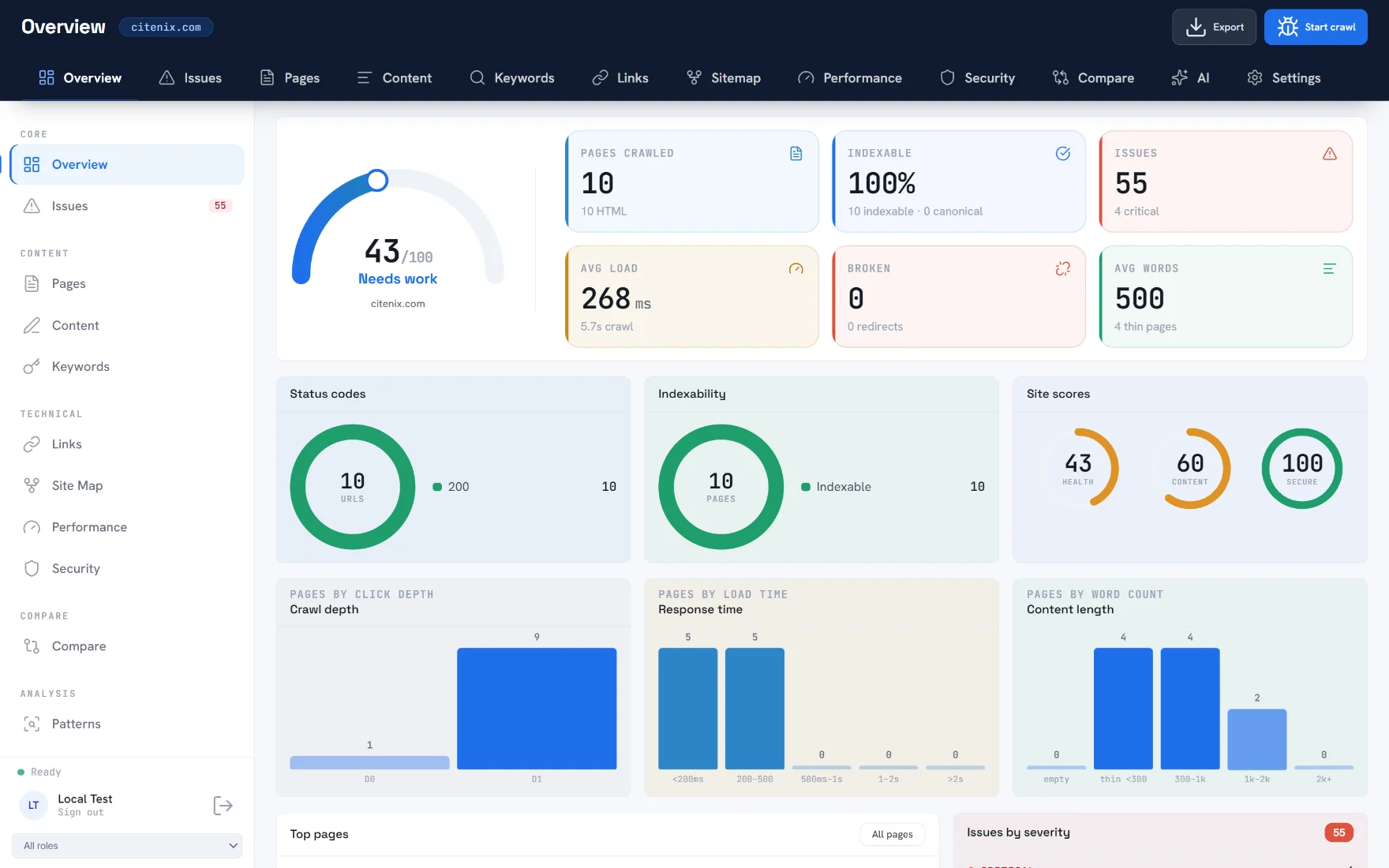
Screaming Frog is genuinely excellent software, and if you love it, keep it. What people want to escape usually isn't the crawling — it's everything around it. The desktop app that eats your RAM on a 200,000-page site. The licence that lives on one laptop. Crawls that vanish when the window closes. And the fact that the output is a spreadsheet you then have to turn into something a client can read.
Citenix crawls server-side. You start a crawl in the browser, close the tab, and go do something else; it keeps running on our infrastructure and the results are waiting for you — and for everyone else on your team. Crawls survive our own deploys by checkpointing and resuming, and several run in parallel.
| Capability | Screaming Frog | Citenix |
|---|---|---|
| Where it runs | Desktop app (your machine, your RAM) | Our servers — close the tab, it keeps going |
| Free tier | 500 URLs | 2,000 pages/day |
| Team access | Per-seat licence, results local | One workspace, everyone sees the same crawl |
| Status codes, redirects, titles, meta, canonicals, hreflang | Yes | Yes |
| JavaScript rendering | Yes (all-or-nothing) | Static-first, renders only pages that need it |
| Re-crawl cost | Full re-crawl each time | Conditional requests skip unchanged pages |
| robots.txt + crawl-delay | Yes | Yes, plus automatic back-off when the server slows |
| Crawl survives interruption | No | Checkpoints and resumes |
| Output | CSV/Excel export you assemble | Dashboards, prioritised issues, client-ready reports |
| Log file analysis | Separate Log Analyser product | AI-bot log analysis only |
| Price | ~£199/year per seat | Free tier, then from $78/month for the whole platform |
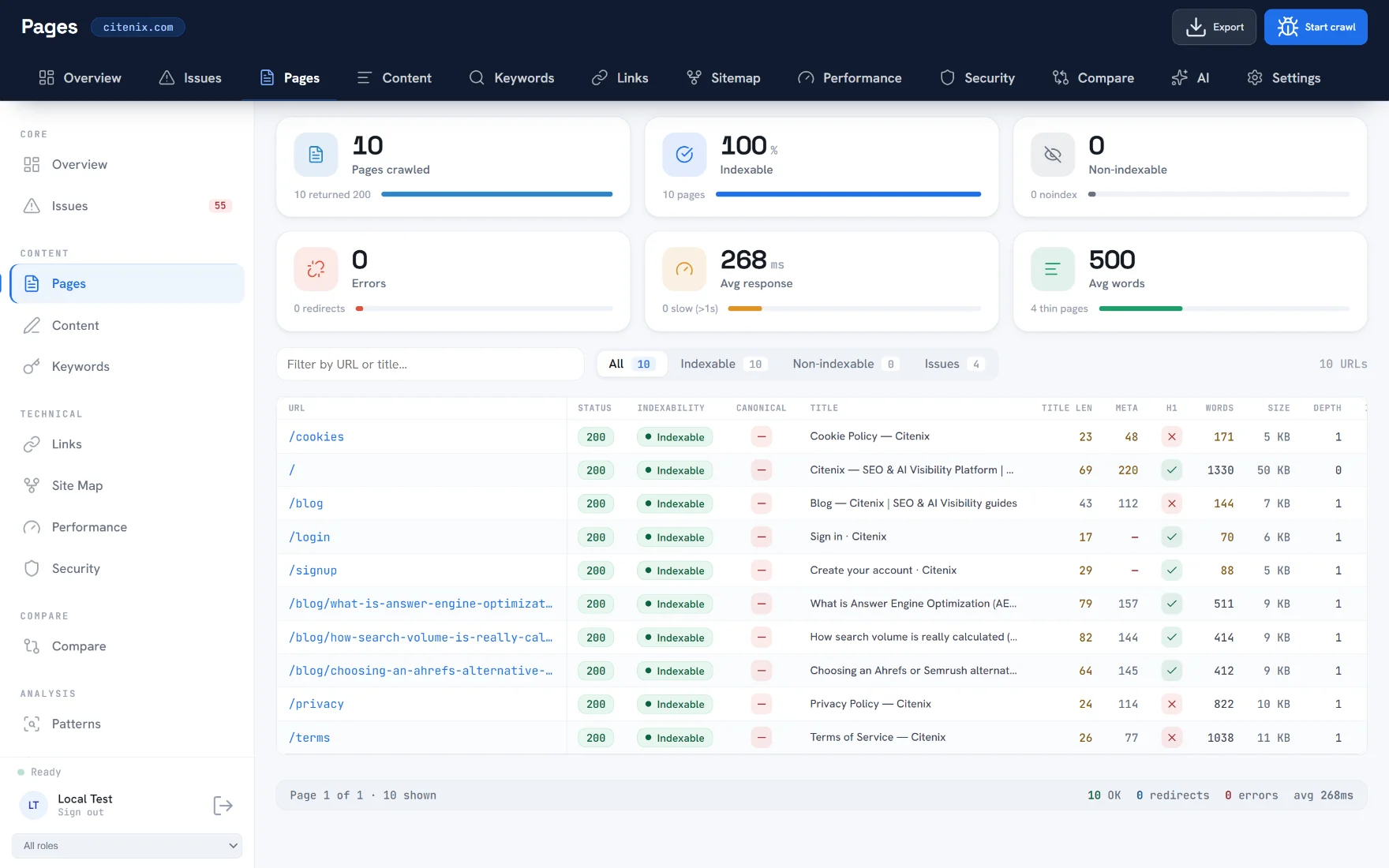
One detail worth checking in whatever tool you use today: indexability honesty. A page returning 404 with a noindex tag is not "indexable", and an unknown status should be treated as unknown rather than assumed to be 200. That sounds obvious — it's also a bug a user caught in our product, which we fixed.
Citenix as a Semrush alternative, part one: the Site Audit
Semrush's Site Audit produces a long list of problems and a score. The complaint we hear isn't that it's wrong — it's that it's flat. Four hundred issues, all shouting at once, no sense of which three matter this week.
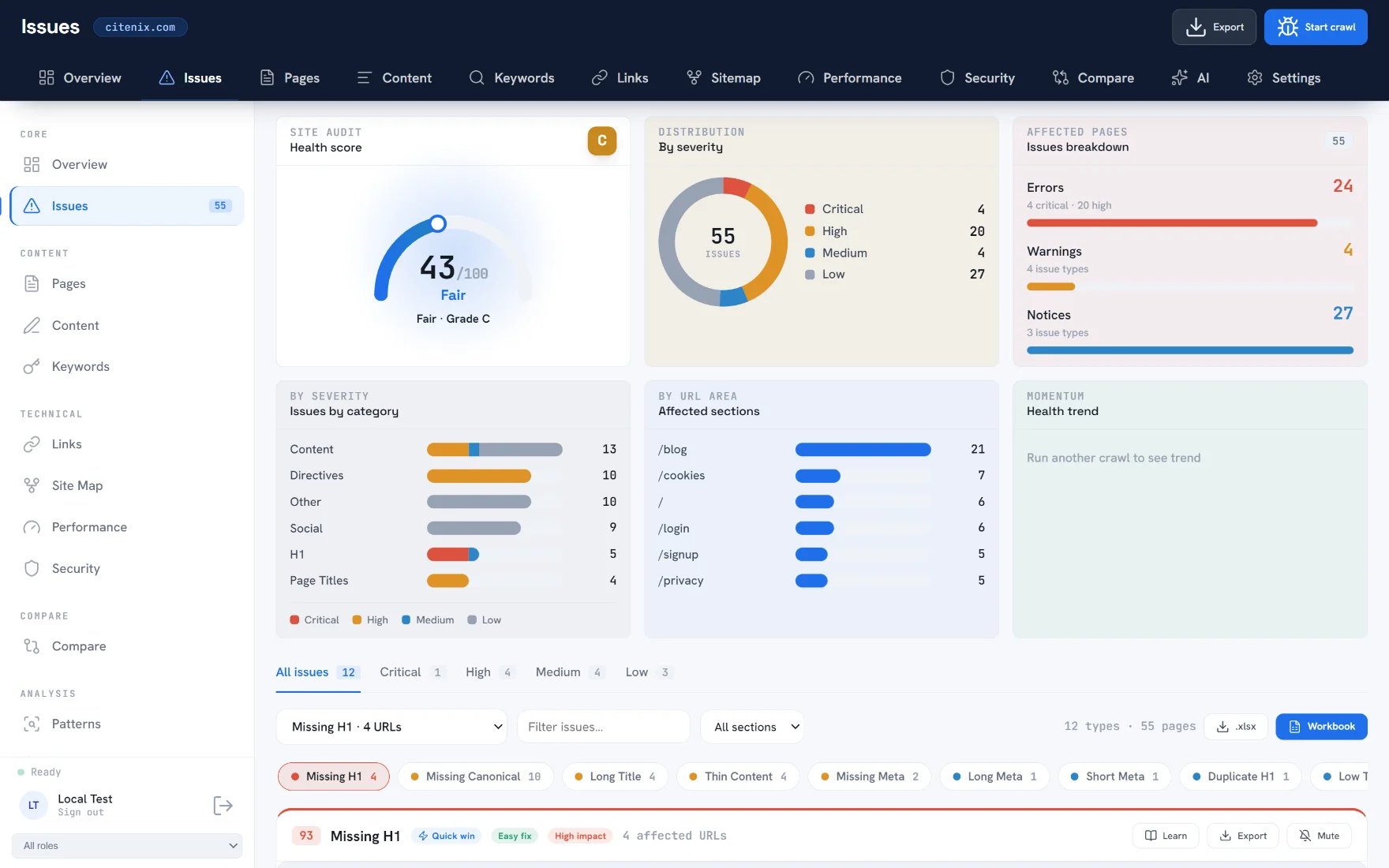
Citenix ranks issues by impact and effort, groups them by pattern and by site section, and gives each one the affected URLs plus what to do. It also tracks status — ignore, snooze, mark fixed, recheck — so a recurring audit stops being a fresh wall of 400 rows every month.
| Capability | Semrush Site Audit | Citenix |
|---|---|---|
| Issue list with severity | Yes | Yes, ranked by impact and effort |
| Grouped by pattern / section | Limited | Yes — by issue type and URL area |
| Per-issue guidance | Yes | Yes, with the affected URLs inline |
| Ignore / snooze / mark fixed | Partial | Yes, with recheck |
| Crawl-over-crawl diff | Yes | Yes — what broke, what you fixed |
| Core Web Vitals | Yes | Yes (Lighthouse lab + CrUX field data) |
| Export | CSV / PDF | CSV, Excel workbook, shareable white-label report |
| AI-crawler access checks | No | Yes — whether GPTBot and friends can read your site |
That screenshot cost us some pride, which is rather the point. The same crawl surfaced the broken blog links in the intro, the missing canonicals, and four pages without an H1 — all real, all now fixed.
Citenix as an Ahrefs alternative
The honest part first: Citenix does not have a backlink index. Ahrefs has been building a link graph for over a decade and we have not. If your work depends on backlink analysis — link prospecting, disavow audits, competitor link-gap analysis — keep Ahrefs, or keep a seat somewhere that has an index. No amount of marketing copy from us changes that fact. We wrote about how to think through that trade-off in more detail in choosing an Ahrefs alternative.
| Capability | Ahrefs | Citenix |
|---|---|---|
| Backlink index | Yes — the reason to keep it | No |
| Referring domains / link gap | Yes | No |
| Keyword research | Yes, huge database | Yes — with each volume graded by evidence |
| Search volume confidence shown | No grade | Measured / calibrated / modeled, per keyword |
| Rank tracking | Yes, metered by plan | Yes — daily checks included, not per-check billed |
| Site audit / crawl | Yes | Yes |
| Search Console integration | Yes | Yes — used to derive true volume + click opportunity |
| Content decay detection | Limited | Yes, from your own GSC rolling windows |
| AI visibility measurement | Basic mentions | Core product — grounded vs parametric, citations, fix plans |
| Entry price | ~$129/month | Free tier, then $78/month |
Why the volume grading matters: a tool that says "1,300 searches/month" with no confidence signal is making a promise it can't keep. If you're going to plan a quarter of content around a number, you deserve to know whether it was measured from your own data or modelled from a pattern. We explain exactly how those numbers are produced in how search volume is really calculated.
Citenix as a Semrush alternative, part two: keywords and tracking
Semrush's other half — Keyword Magic, position tracking, content templates — overlaps heavily with the section above. The practical differences teams notice after moving:
| Capability | Semrush | Citenix |
|---|---|---|
| Keyword research | Yes | Yes, graded volumes + intent classification |
| Position tracking | Yes (limits by plan) | Yes — plan includes tracked-keyword slots, swept daily |
| Live SERP analysis | Yes | Yes — organic results, difficulty proxy, People Also Ask |
| Crawl allowance | Metered tightly | Generous — 10k/day Starter, 50k/day Growth, 200k/day Agency |
| Paid-search / ad intelligence | Yes | No |
| Local SEO / listings | Yes (add-on) | No |
| White-label reports | Yes | Yes — live shareable URL + Excel workbook |
| Multi-site switching | Per-project | One site identity across every view, switched in one click |
| Entry price | ~$140/month | Free tier, then $78/month |
Two things worth calling out. First, crawling is generous because it costs us little — it runs on our own infrastructure, so we don't meter it tightly. Credits are consumed by work that costs real money: a keyword research run is 10 credits, a live SERP lookup 1, an AI visibility run 20. Every rate is visible in your account.
Second, one site identity across every view. Switch the site you're working on and every panel switches with it. That sounds trivial until you've been burnt by a dashboard quietly showing last month's client data.
Citenix as a Profound, Peec AI or Otterly alternative
This is the part we built the company around, so read it sceptically and then go test it. If the category is new to you, start with what Answer Engine Optimization actually is.
AI visibility tools answer one question: when someone asks an AI assistant about your category, do you get mentioned? The category is young and rigour varies wildly. Three things we do differently, all of which you can verify:
Grounded answers and remembered ones are not the same thing
When ChatGPT answers using live web search, that's a grounded answer — it fetched pages, and you can influence it by being citable. When it answers from training data alone, that's parametric — a reflection of what the model absorbed months ago. Different problems, different fixes. A tool that averages them into a single "AI visibility score" is telling you very little. Citenix reports them separately.
Real people type keywords, not just polite questions
Early on we made the mistake most tools still make: we tested tidy natural-language questions like "what is the best CRM for small agencies?". Then a site with real, measurable ChatGPT referral traffic in its GA4 scored close to zero in our own probes. The reason: people type keyword-shaped queries too, and Google's AI Overviews are triggered by keyword searches, not questions. The tracked surface now deliberately mixes both.
A score is not an action; a citation list is
The useful output isn't the percentage, it's the citation list: which domains and URLs the engine actually used as sources. From there Citenix scores your own pages for citation-readiness and generates a fix plan — because "be more visible in AI" is not a task, while "add a comparison table and a direct answer near the top of this specific page" is.
| Capability | Typical AI-visibility tool | Citenix |
|---|---|---|
| Brand mention tracking | Yes | Yes |
| Grounded vs parametric separated | Rarely | Yes — reported as distinct evidence classes |
| Query mix tested | Usually questions only | Questions and keyword / long-tail queries |
| Prompt set | You write them | Predicted from your site's real demand, fully editable |
| Citation sources listed | Sometimes | Yes, per run, per engine |
| Page-level citation readiness | No | Yes — scored, with a fix plan |
| AI referral traffic joined to visibility | No | Yes, via the built-in analytics |
| Technical SEO in the same tool | No | Yes |
Want to test before signing up for anything? Run a free scan — enter a domain and see whether AI engines name that brand, who they recommend instead, and which sites they cite. No account needed for the first result.
Citenix as a Surfer SEO or Clearscope alternative
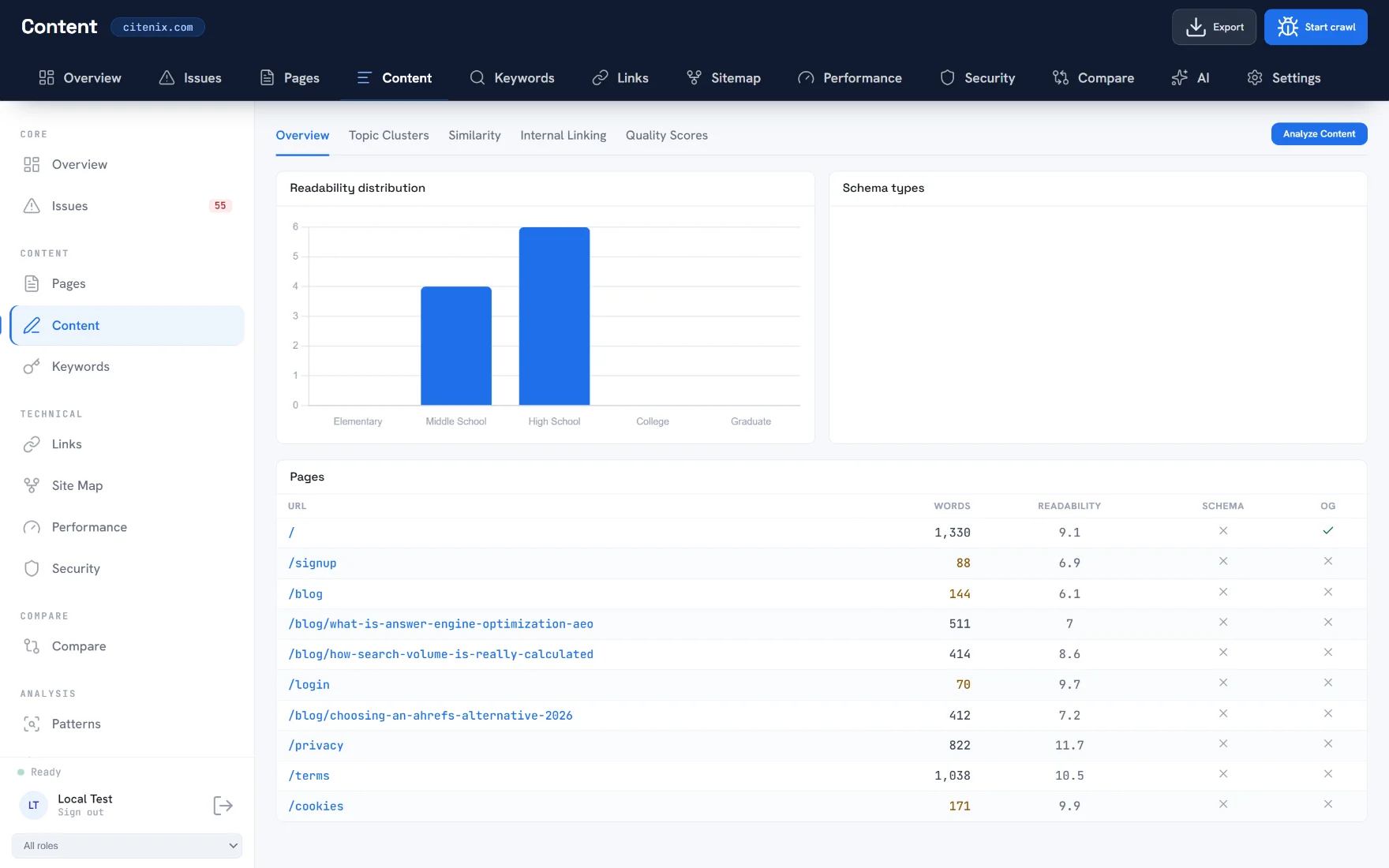
Content optimisers grade a draft against the pages currently ranking. Citenix does that too, but ties it to pages you've actually crawled rather than text you paste into a box.
| Capability | Surfer / Clearscope | Citenix |
|---|---|---|
| Score a draft against the live SERP | Yes | Yes |
| Where the target query comes from | You supply it | Your Search Console impressions, per page |
| Subtopic coverage gaps | Yes | Yes, measured against the live SERP |
| Tied to crawled pages | No — paste-in editor | Yes — every crawled URL is scorable |
| In-editor writing workflow | Yes | No — briefs and scores, write where you like |
| Content decay detection | No | Yes, from GSC trends |
| Cannibalisation detection | No | Yes, via page embeddings |
Citenix as a Google Analytics 4 alternative
Nobody enjoys GA4. The usual escape is Plausible or Fathom for simplicity — but then your analytics live even further from your SEO data.
Citenix includes a first-party analytics tracker: one snippet, and it sets no cookies at all. It stores a random identifier scoped to your site alone — no cross-site tracking, no data sold, no profile building. Details are in our privacy policy.
| Capability | Google Analytics 4 | Citenix Live Analytics |
|---|---|---|
| Cookies required | Yes | None — cookieless by design |
| Real-time visitors | Yes | Yes |
| Sources & UTM campaigns | Yes | Yes |
| Goals / conversions | Yes (event config) | Yes — URL-based goals with no code, or custom events |
| E-commerce revenue | Yes | Yes |
| Journey funnel | Yes | Yes — source → landing → engagement → next page |
| Click heatmaps | No | Yes |
| AI referral traffic identified | Not out of the box | Yes, and joined to your AI visibility data |
| Multi-channel attribution modelling | Yes | No |
| Data retention | Capped by default | Yours, in your account |
The reason analytics belongs in an SEO platform at all is that last row but one: AI referral traffic. Assistants send real visits, and Citenix identifies that traffic and joins it to your AI visibility data. That's the loop most stacks can't close — you can see that you got cited, and separately that traffic arrived, but not that they're the same story.
Citenix as a Hotjar alternative
Not a full replacement, so let's be precise.
| Capability | Hotjar | Citenix |
|---|---|---|
| Click heatmaps | Yes | Yes — real recorded clicks over a page screenshot |
| Scroll depth | Yes | Yes |
| Session replay | Yes | No |
| On-site surveys / feedback | Yes | No |
| Funnels | Yes | Yes, in the same journey view as your SEO traffic |
If you use Hotjar mainly to see where people click on key landing pages, that's covered. If you rely on session replay and on-site surveys, keep Hotjar.
Citenix and Google Search Console: a companion, not a replacement
Nothing replaces GSC. It's Google's own data about your site, it's free, and you should always have it connected. Citenix reads it — with your permission, through Google's official OAuth — and does the things the GSC interface won't: derive true search volume from your impressions, compute the click opportunity of moving a keyword from position 6 to position 3, detect content decay by comparing rolling windows, and join all of it to your crawl.
What Citenix does not replace
The short, honest list:
- Backlink indexes. No link graph, no referring-domain database, no link-gap analysis.
- Session replay and on-site surveys. See the Hotjar section.
- Paid-search and ad intelligence. If you use Semrush for competitors' ad copy and PPC estimates, that isn't us.
- Log file analysis at scale. There's a lightweight AI-bot log analyser, but a dedicated log analyser it is not.
- Local SEO and listings management. Not built.
- Attribution modelling. Our analytics report what happened, not modelled multi-touch credit.
If two or more of those are core to your job, you'll run Citenix alongside something else rather than instead of it. That's a perfectly good outcome, and we'd rather you knew now than after a migration.
The cost math
Sticker prices move, so treat these as an anchor and check each vendor's own page. Roughly, as of July 2026:
| What it's for | Typical tool | Indicative price |
|---|---|---|
| Crawling & technical audits | Screaming Frog | ~£199/year per seat |
| Keywords, rankings, backlinks | Ahrefs (entry plan) | ~$129/month |
| Keywords, audit, position tracking | Semrush (entry plan) | ~$140/month |
| AI visibility tracking | Profound / Peec / Otterly | ~$30–$500+/month |
| Content optimisation | Surfer / Clearscope | ~$100+/month |
| Heatmaps | Hotjar | ~$40+/month |
Citenix's pricing is public and rendered live from the same plans we bill on — see current plans: Free ($0, 100 credits/month), Starter ($78), Growth ($198), Agency ($498) and Scale ($1,198). Crawl allowances are deliberately generous at every tier because crawling runs on our own infrastructure.
The honest framing: if you need a backlink index, you're adding Citenix to one suite rather than replacing two. If you don't, most teams collapse three or four bills into one.
How to switch in an afternoon
- Crawl your site. Sign up, add your domain, start a crawl. Nothing else needs configuring first.
- Connect Search Console. The highest-value five minutes of the whole setup — it upgrades keyword volumes from modeled to measured and unlocks decay detection.
- Read Issues, not the score. Sort by impact, fix the top three, mark them for recheck.
- Run one AI visibility analysis. Even if AI isn't your priority yet, the citation list tells you which sites shape the answers in your category.
- Install the tracking snippet if you want AI referral traffic joined to everything else. One line of JavaScript.
- Re-crawl in a week and open Compare. That diff — what broke, what you fixed — is the habit that actually moves sites.
Frequently asked questions
Is Citenix a full Ahrefs replacement?
Not if you need backlink data — Citenix has no backlink index, and that is the main reason to keep an Ahrefs seat. For keyword research, rank tracking, SERP analysis, technical auditing and content work it covers the same ground, and it adds AI visibility measurement that the traditional suites don't match.
Can Citenix crawl large sites?
Yes. Crawls run server-side on a distributed job queue, checkpoint and resume across deploys, and several run at once. Page allowances reach 50,000 a day on Growth and 200,000 a day on Agency.
Do I need to install anything?
No. Citenix runs in the browser — there is no desktop application. The only optional install is the analytics snippet, which is a single line of JavaScript.
How does Citenix measure AI visibility?
It runs your tracked query set across multiple AI engines, reports grounded results (live web search) separately from parametric ones (model memory), and repeats over time so you see a trend rather than one lucky sample. Citations are recorded per run, so you can see exactly which sources each engine used.
Does Citenix replace Google Analytics?
For most SEO reporting, yes — it gives you real-time traffic, sources, campaigns, goals, e-commerce revenue and journey funnels without cookies. It does not do multi-channel attribution modelling, so if that's central to your reporting, keep GA4 alongside it.
What happens to my data if I leave?
Export what you need — CSV, Excel workbook, shareable reports — then delete your account, which removes your tenant data. The details are in our privacy policy.
The short version
If your work is backlink-led, keep your suite and use Citenix for the crawl, the content work and the AI visibility. If it isn't, there's a good chance one subscription covers what three or four are doing now — and everything sits in one place, keyed to one site, so the crawl, the keywords, the AI answers and the real traffic finally describe the same website.
You can find out in about ten minutes: start a free crawl, or run a free AI visibility scan without an account. If our crawler finds something embarrassing on your site, you'll be in good company — it found ours.